
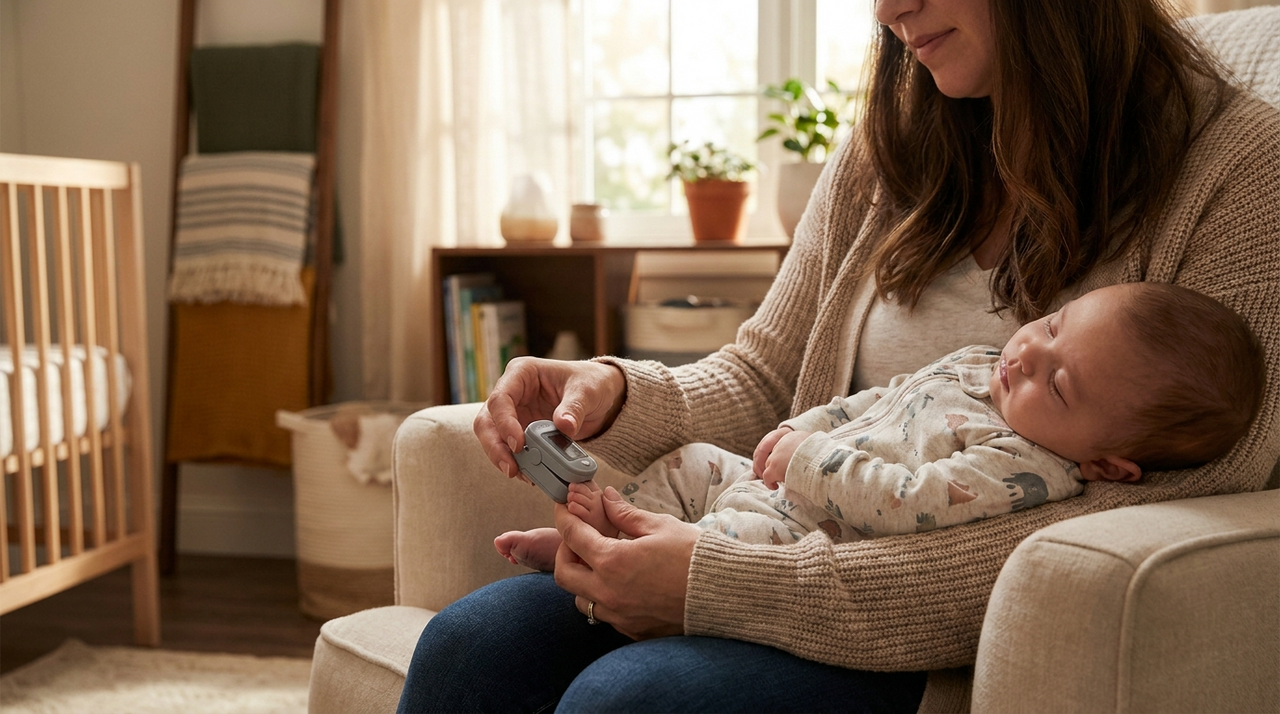
A pediatric pulse oximeter allows you to quickly and painlessly measure a baby's or child's blood oxygen (SpO2) and pulse at home. We explain if it can be used on little ones, what values are normal by age, how to place it correctly, and when to call the pediatrician.
Can a pulse oximeter be used on babies and children?
Yes. There are pediatric pulse oximeters designed for small fingers, and it can also be measured on a baby's toe. The measurement is painless (a clip with a light sensor) and very useful for monitoring respiratory conditions such as bronchiolitis, asthma, or colds with breathing difficulties. It does not replace the pediatrician but helps you know when to seek advice.
Normal SpO2 values in children
In healthy children, normal oxygen saturation is 95% to 100%, just like in adults. As a general reference:
| SpO2 | Indicative Interpretation |
| 95–100 % | Normal |
| 92–94 % | Monitor; consult if symptoms are present |
| Less than 92 % | Consult with pediatrician / emergency services |
These are indicative values: in premature babies or those with medical conditions, the thresholds may vary, and medical judgment should always take precedence.
How to place the pulse oximeter on a child or baby
- Choose a time when the child is calm and still: movement can skew the reading.
- Make sure the finger (or foot) is warm; cold lowers the signal.
- Position the sensor so that the light passes through the finger properly and wait about 30–60 seconds for the reading to stabilize.
- Remove any nail polish or plasters covering the area.
- Repeat the measurement if the reading fluctuates significantly or the device does not detect a pulse.
When to consult the pediatrician
Seek medical attention if the child consistently shows SpO2 below 92%, breathes very rapidly or with effort (ribs are prominent), has bluish lips, is very lethargic, or has difficulty eating due to breathing problems. When in doubt, always consult.
Which pediatric pulse oximeter to choose
At Ortopedium, you can find the Sanitec Pediatric Pulse Oximeter, designed for measuring oxygen and pulse in children, within our collection of pulse oximeters. If you want to understand the measurement in depth, we also have our general guide on how to use a pulse oximeter and normal SpO2 values.
Frequently Asked Questions
What oxygen saturation is normal in a child?
In healthy children, normal SpO2 is 95% to 100%. If it's consistently below 92%, it's advisable to consult a pediatrician.
Can I use an adult pulse oximeter on a baby?
It may give less reliable readings due to finger size. For babies and young children, a pediatric pulse oximeter or measuring on the toe with the child still is preferable.
Does it hurt to measure a child's oxygen?
No. The pulse oximeter is a painless clip that measures with light through the finger or foot, without needles.